
The National Payments Corporation of India (NPCI) stated that the Merchant Discount Rate (MDR) "is distributed only amongst the UPI ecosystem, to further invest into infrastructure resilience, innovation, cybersecurity (protecting the UPI infrastructure with banks and non-banks) and customer service."

Indian benchmark indices, Sensex and Nifty, saw a significant rebound in early trade, with the Sensex jumping 726 points and the Nifty climbing over 200 points, primarily driven by strong performances in IT stocks, HDFC Bank, and renewed foreign fund inflows. Track Sensex, Nifty on July 29.

Indian benchmark indices Sensex and Nifty experienced declines in early trade, driven by a surge in Brent crude oil prices above USD 91 per barrel due to escalating tensions between Iran and the US, alongside an increase in US 10-year bond yields. Track Sensex, Nifty on August 18.

The Indian government has introduced a 0.4% Merchant Discount Rate (MDR) on UPI person-to-merchant (P2M) transactions exceeding Rs 2,000, effective October 15. This move ends nearly six years of fully free UPI payments, though person-to-person (P2P) transfers and small P2M payments remain free. The charges aim to bolster investment in UPI infrastructure, with specific exemptions and caps for essential sectors.
ICICI Bank, India's second-largest private-sector lender, is set to raise approximately $500 million through an overseas dollar bond issuance, marking its first such move in nearly a decade. This fundraising effort will utilise the Reserve Bank of India's (RBI) concessional swap window, a facility designed to reduce hedging costs for foreign currency borrowings.

The Indian government has introduced a 0.4 per cent Merchant Discount Rate (MDR) on UPI payments exceeding Rs 2,000 made to merchants, effective from October 15, with a comprehensive framework set to take full effect by October 15, 2026. This policy aims to regulate transaction fees while protecting small merchants and person-to-person transactions.

The government is introducing a 0.4% Merchant Discount Rate (MDR) on UPI person-to-merchant payments above Rs 2,000, effective October 15. This move ends the zero-MDR regime, aiming to fund UPI infrastructure and sustainability, as the previous government subsidy was insufficient to cover operational costs. Payments between individuals and most everyday merchant transactions will remain free.

The Reserve Bank of India (RBI) has rejected Tata Sons' application to surrender its non-banking finance company (NBFC) licence, a decision that mandates a public markets listing for the conglomerate's holding company as it is classified as an upper-layer NBFC.

The devastating flash floods wreaked havoc across Nepal, with the ministry of external affairs on Thursday stating that 84 Indian nationals have been rescued while 290 remain uncontactable as the Himalayan nation stepped up search, rescue and relief operations following the disaster that has claimed more than 390 lives.

ICICI Bank has successfully raised $1 billion through a five-year senior unsecured US dollar bond, marking its first public dollar bond issuance since 2017 and the largest single-tranche US dollar bond issuance by an Indian issuer so far this year.

Indian benchmark indices, Sensex and Nifty, extended their losses for a second consecutive day, primarily due to HDFC Bank's disappointing quarterly earnings and escalating tensions in West Asia, coupled with persistent foreign fund outflows.

Indian equity benchmark indices Sensex and Nifty rebounded sharply in early trade, with the Sensex jumping over 530 points, tracking a broad-based rally in Asian markets after four consecutive days of decline.
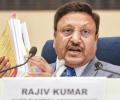
It is because dealing with a regulatory system that is largely headed by retired IAS officers then becomes relatively easy, points out A K Bhattacharya.

BJP MP Raghav Chadha addressed the 12th IPU Global Conference of Young Parliamentarians in Samarkand, Uzbekistan, highlighting India's digital transformation journey. He emphasised how technology is widening access and promoting inclusion, citing UPI's success, affordable data, and robust data protection laws. Chadha also discussed India's digital cooperation with Uzbekistan and the importance of digital rights, safety, and skill development for all citizens.

Finance Minister Nirmala Sitharaman has urged the Reserve Bank of India to accelerate its central bank digital currency initiatives, emphasising the need to sharpen capabilities with the digital rupee amidst rapid advancements in tokenisation, agentic AI, and quantum computing. She also highlighted critical concerns regarding cybersecurity, warning that autonomous AI systems are evolving rapidly and require robust safeguards. Sitharaman proposed a federated industry platform to give India's technology ecosystem a collective international voice.

NPCI International Payments Ltd (NIPL) and Maldives Monetary Authority (MMA) have successfully integrated the Maldives' instant payment system 'Favara' with India's Unified Payments Interface (UPI). This enables real-time fund transfers from Maldives to UPI-enabled Indian bank accounts, marking a significant step in cross-border digital financial connectivity and bilateral economic cooperation.

The Nifty 50 experienced significant volatility during its closing auction session, leading to losses for both long and short retail options traders due to thin liquidity and rapid price swings, particularly in private-sector banks.

Indian benchmark indices, Sensex and Nifty, closed flat on Friday, with elevated crude oil prices due to geopolitical uncertainties and a rebound in US Treasury yields making investors cautious and preventing a decisive market rally.

DIIs invested $22.8 billion in Indian equities in Q2CY26.

Indian benchmark indices Sensex and Nifty experienced significant declines in early trade, driven by soaring crude oil prices amidst escalating tensions in West Asia, coupled with weak global market trends and foreign fund outflows.

Indian benchmark indices, Sensex and Nifty, traded flat in early deals due to elevated crude oil prices exceeding USD 100 per barrel and persistent geopolitical tensions, which subdued investor risk appetite.

India is actively integrating payment system harmonisation into its Free Trade Agreement (FTA) negotiations, especially with countries hosting a large Indian diaspora. This strategy aims to leverage India's growing fintech ecosystem, facilitate cross-border financial services, and position India as a global hub for financial services exports, particularly through platforms like GIFT City.

Indian benchmark equity indices, Sensex and Nifty, closed mixed on Friday. While a drop in crude oil prices offered some relief, weakness in IT stocks and several Tata Group counters, including a significant dip in Tata Chemicals and ongoing boardroom issues at Tata Sons, limited a broader market recovery.

Indian benchmark indices, Sensex and Nifty, traded marginally higher in early trade despite the US Federal Reserve's recent rate hike and indications of further tightening, with the National Stock Exchange's much-anticipated Rs 22,569-crore IPO also opening for subscription.
Indian benchmark indices Sensex and Nifty experienced a significant tumble in early trade, primarily driven by heavy selling in HDFC Bank following its quarterly earnings and a sharp spike in Brent crude oil prices due to escalating tensions between the US and Iran. Track Sensex, Nifty
Unified Payments Interface (UPI) transactions in India reached Rs 29.8 lakh crore in August, approaching record levels. Volume also hit a new high of 24.51 billion transactions, driven by festive activities like Raksha Bandhan. The digital payment system continues its rapid growth, expanding its global presence to 11 countries, with further growth anticipated during the upcoming festive season and new use cases like credit on UPI.
Indian benchmark indices, Sensex and Nifty, saw an early rebound after significant losses, driven by value buying, though elevated oil prices and anticipation of the US Federal Reserve's policy decision tempered gains. Track Sensex, Nifty on September 16.

Shares of major private lenders, including HDFC Bank, Axis Bank, and Kotak Mahindra Bank, experienced a sharp selloff after their June-quarter results indicated persistent pressure on net interest margins (NIMs), despite healthy credit growth. This decline overshadowed gains in ICICI Bank and Punjab National Bank (PNB), which reported resilient or stronger-than-expected earnings.
The Indian rupee experienced its sharpest single-day decline in eight weeks, settling at 94.83 per dollar, primarily due to escalating crude oil prices and persistent risk-off sentiment driven by heightened geopolitical tensions and limited foreign inflows.

Defending champions India's women's cricket team is set to face Bangladesh in the Asian Games semifinal. With a dominant head-to-head record, India aims to continue their winning streak, while Bangladesh will rely on their spinners to challenge the strong Indian batting lineup for a spot in the final.

Sumit Nagal, India's top singles player, believes sheer desire will be crucial in the Davis Cup qualifier against Korea, especially on the slow Seoul courts.
The benchmark BSE Sensex rebounded by 362 points, ending a four-day losing streak, driven by strong buying in metal, private banking, and oil and gas shares, while the broader NSE Nifty saw modest gains despite paring some advances in the closing session.

The benchmark Sensex plummeted 813 points to a three-month low, with the Nifty settling below 23,450, as escalating tensions in West Asia drove crude oil prices above USD 100 per barrel, leading to widespread selling in IT, FMCG, financial services, and oil & gas shares.
Indian benchmark indices Sensex and Nifty closed lower, with the Sensex dropping 388 points and Nifty declining 112 points, as a sharp rally in crude oil prices, driven by geopolitical uncertainties and concerns over the Strait of Hormuz, dampened investor sentiment and reignited inflation fears.

Indian companies, including NBFCs, filed proposals to raise $7.696 billion through external commercial borrowings (ECBs) and foreign currency convertible bonds (FCCBs) in July 2026, a significant increase from $6.09 billion in June.
Indian benchmark equity indices, Sensex and Nifty, closed lower for multiple consecutive days, with the Nifty extending its losses to a seventh day, primarily due to elevated crude oil prices following the expiry of the US-Iran ceasefire without a diplomatic resolution.
India's Unified Payments Interface (UPI) recorded an unprecedented 24.51 billion transactions valued at Rs 29.8 lakh crore in August, largely propelled by the Raksha Bandhan festival. This surge marks a 22% annual increase in volume and 20% in value, highlighting the expanding reach and depth of the UPI ecosystem. Experts anticipate further growth during the upcoming festive season, while UPI's international acceptance now spans 11 countries.

Anant Nag has dedicated the Dadasaheb Phalke Award 2024 to the people and unique cultural environment of Karnataka, crediting the state for his unparalleled success in both art and commercial films.
Indian benchmark indices, Sensex and Nifty, saw declines in early trade due to escalating crude oil prices and ongoing US-Iran hostilities, which subdued investor risk appetite.

Indian benchmark indices, Sensex and Nifty, experienced declines in early trade due to a surge in crude oil prices and significant selling pressure on bank stocks, impacting overall investor sentiment. Track Sensex, Nifty on July 22.
